All posts by Financial Independence Hub

A snapshot of Canadian investors’ appetite for risk: Vanguard’s Canadian risk speedometers

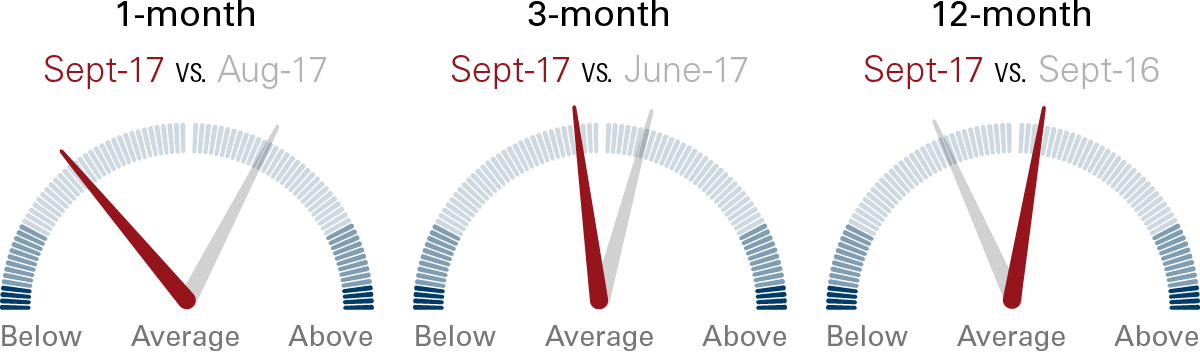
Figure 1: Vanguard’s Canadian risk speedometers, September 30, 2017

By Todd Schlanger, Senior Investment Strategist, Vanguard Canada

(Sponsor Content)

As part of Financial Literacy Month in Canada, we are proud to announce the launch of Vanguard’s Canadian risk speedometers.

These speedometers were originally designed by my colleagues in the United States to provide a factual representation of how investor risk appetite is trending today, relative to the past.

In order to generate the speedometers, we calculated net cash as a percentage of total assets under management, (in this case, within the universe of Canadian mutual funds and ETFs) into high-risk and low-risk asset categories. We then looked at the relative cash flows into high- versus low-risk asset classes, relative to history.

The end result is a risk measure that can be tracked through time and displayed in a risk speedometer index, as shown in Figure 1 over the 1-, 3-, and 12-month periods ending September 30, 2017. When risk appetite is above its historical average — such as over the 12-month period — the needle is to the right of centre, indicating higher risk appetite. When the needle is to the left of centre, risk appetite is below average. In addition to the current risk appetite readings, we also display the prior 1-, 3-, and 12-month readings for comparison.

Notes: Vanguard’s risk speedometers measure the difference between net cash flows into higher-risk asset classes and lower-risk asset classes, in this case within the universe of Canadian mutual funds and ETFs. The lighter-shaded areas represent values that are within one standard deviation of the mean, which means they occur roughly 68.2% of the time (34.1% higher and 34.1% lower). The middle shades represent readings between one and two standard deviations from the mean, occurring 27.2% of the time (13.6% higher and 13.6% lower). The dark edges represent values more than two standard deviations from the mean, occurring the remaining 4.6% of the time (2.3% higher and 2.3% lower). Speedometer values for previous periods may change from what was initially reported as the current value in prior periods because of changes made in Morningstar, Inc., data, and to the updating of the five-year average.

Along with the risk speedometers, we will be providing underlying asset category details (the top winners and losers in each category) in terms of net cash flows and changes in assets under management that resulted in the current risk appetite readings, as shown in Figure 2 (for the same periods, ending September 30, 2017).

Figure 2: Highest net inflows and outflows Continue Reading…

Mobile Personal Finance apps for Millennials seeking Financial Independence

By Reviews Bee

Special to the Financial Independence Hub

Smartphones and apps have enormously affected our daily life and financial management. And despite the fact the elder generation may still have some doubts about tracking incomes and expenses,  millennials are more likely to connect their financial independence with these apps.

The fact is many mobile apps nowadays enable quickly entering data on incomes and expenses, and to find information about completed operations, make changes, export the database or restore it from a backup, and track your expenses and income. They give you some perspective on major and minor decisions in life so it becomes much easier to make  right decisions on the flow of your personal money.

When choosing a program, it’s important to consider not only functionality and convenience of interface but also safety. To be sure the financial apps will not let you down, we have considered  functional peculiarities and user reviews of many similar mobile apps, on the basis of which we present some of the best ones:

Mint

The Mint application helps to form a budget, track expenses and achieve financial goals. Costs and savings can be easily tracked in a special list, where different types of financial transactions are marked with different colors, as well as in the tables and charts that the application forms.

Users can also track movements on their bank accounts and credit-card balances in real time, monitor investments and even break their expenses into categories.

In addition, you can set up alerts if it’s time to pay bills, or if users have exceeded their budgets. Another convenient feature: a weekly consolidated report of the movement of your funds is available.

Wally

Continue Reading…

Make & Save: The importance of actionable Personal Finance habits

By Hellen McAdams

Special to the Financial Independence Hub

When it comes to actionable personal finance habits, earning more money and saving a good portion of it are near the top of the list. Sadly though, before you can ascend the tower of wealth, many of us need to first dig out of the basement of debt.

Escape Debt in 5 years

Did you know the average American household has approximately $137,063 in debt? (all figures $US.) That’s too much debt. But what if you were to discover it’s possible for the average household to get out from under the thumb of that kind of debt in as little as five years?

There are several ways to do this. Loan consolidation is a practice whereby you reduce the complication of managing debt by combining everything together. If you have a bunch of little debts that individually compound separately from one another, one possible solution could be to take out a small loan, pay them off, then pay off the small loan in a single payment from then on.

There are online loans of this type which can, believe it or not, be secured online, if you’re considering such.

Still, this is just a debt transition; it doesn’t truly get rid of that which you owe: it merely reduces the complexity of paying a dozen little things off in tiny increments; like cellphones, furniture, and medical bills. A better way to get your debt paid off more quickly is to downsize.

Debt Relief Strategy

This is where you have to establish good financial habits. This hypothetical revolves around $3,000 a month in earnings from the primary breadwinner of the household. That comes to $36,000 a year before taxes. Now say you’ve got $137,000 in debt hanging over your head. You need to find a way to pay that off with the money you’ve got. Continue Reading…

How alternative investments protect your Retirement in a down market

By Matthew Ardrey

Special to the Financial Independence Hub

When I review the portfolio of new clients as part of their financial plan, they almost always have at least one of the following concerns on their mind. They ask how long can stocks continue to climb, given it has been an eight-year bull market or how can their portfolio earn any income with interest rates being so low. More often than not they ask both.

These are real concerns I hear from real people I meet. More and more I am finding that traditional investment solutions are not enough on their own.

Consider how our investment world has changed since 1990. In 1990, an investor could purchase a Government of Canada bond yielding 9.9%, invest in equity markets with a 15X Price Earnings Valuation and lived on average to age 77. In 2017, that same Government of Canada bond yields 1.5%, the Price Earnings Valuation has increased to 22X and average life span is 82 years.

Coping with longer lives, low interest rates and inflation

So the average Canadian investor is now facing a longer life, with fully valued or overvalued equity markets and a fixed-income yield that barely keeps up with inflation even before taxes. Traditional investments can offer little in the way of a solution, especially without increasing the risk profile of my client.

This is where alternative investments can add real value to a portfolio.

Many alternative investment strategies provide yields well in excess of the 1.5% bond yield mentioned above, often averaging annual returns in the 6 to 8% range. The income produced from this part of the portfolio can be used to supplement the low current yields on fixed income.

In addition to return enhancements, alternative investments have a very low correlation to traditional investment markets. What this means is, their performance is not meaningfully impacted by changes in the equity markets. This not only provides diversification, but also portfolio preservation in times of negative volatility.

What are alternative investments? They are any investment that is not a public stock, bond or cash security. Some examples would be private debt, infrastructure, real estate and private equity. They invest in private income oriented investments they can generate stable, high levels of income or by using sophisticated equity hedging strategies to reduce volatility.

Alternatives can have barriers to entry

As with all great things, many investors will wonder, “What’s the catch?” Though there is no “catch” with alternative investments, there are barriers to entry for the average investor. The two main barriers to investing in alternative investments are:

  1. High investment minimums because the investor is not an Accredited Investor (has $1 million in investable assets or $300,000 of income)
  2. Many financial firms do not have the specialized skill set to analyze these investments and thus do not offer them

Though these barriers exist, they can be surmounted by engaging with an appropriate investment counselling firm. The advice provided by an investment counselling firm will allow an investor to access the alternative investment even if not accredited. The firm chosen should have a process to identify alternative investment solutions with proven money managers who have strong track records and a disciplined investment process. Thus, they can engage in the relationship with the alternative investment manager on your behalf.

During the past 30 years, pension plans have been achieving some of the highest returns. It is no coincidence that during the same time period their allocation to alternative investments has also increased substantially to enhance returns and decrease volatility risk.

Institutions have tripled allocation to alternatives

According the annual asset mix report produced by the Pension Investment Association of Canada, which reports on the $1.6 trillion invested by Canadian pensions, the allocation to alternative investments has increased from 10% in 1990 to 33% in 2015. This is an increase of over 200%!

These funds hold the financial future of thousands if not millions of Canadians in their hands. The “smart money” is moving out of the traditional investment world into the alternative one. Now you have the opportunity to do the same.

The world was a very different place in 1990. Brian Mulroney was Prime Minister of Canada, Microsoft released version 3.0 of Windows and The Simpsons first aired on TV. It only makes sense that the investing world would have changed since that time too. If your portfolio isn’t positioned to take advantage of the new investing reality, then my only question is what are you waiting for?

Matthew Ardrey, CFP, R.F.P., CIM, FMA is a VP, Wealth Advisor with TriDelta Financial. He has been providing unbiased advice to his clients on their financial planning and investment management needs since 2000. He can be reached at matt@tridelta.ca.


Should buyers make a move in slower Autumn housing market?

By Penelope Graham, Zoocasa

Special to the Financial Independence Hub

Depending on where you live in Canada, purchasing real estate in recent years hasn’t exactly been a cakewalk. Tight supply and rampant buyer demand (and alleged speculative investing) have pushed home prices to what some experts argue are unsustainable levels in the nation’s hottest markets.

However, following a slew of new policy changes introduced over the last year — such as Metro Vancouver’s foreign buyer tax and the Ontario Fair Housing Plan — those red-hot conditions have changed, with real estate boards from both markets reporting slower sales in the months following.

That’s made a dent in the national numbers, reveals the latest analysis from the Canadian Real Estate Association: with a 11 per cent drop in sales from last September. This is despite the typically busier autumn market, which is often the last chance for buyers to make a serious go of it before the snow — and holiday season — sets in. Seasonally adjusted activity was up slightly month over month at 2.1 per cent.

Too soon to call for market stability: CREA

While this could indicate market conditions are starting to settle after what has been a turbulent spring and summer market, it’s too soon to call it a trend, say CREA’s analysts.

“National sales appear to be stabilizing. While encouraging, it’s too early to tell if this is the beginning of a longer-term trend,” stated CREA President Andrew Peck.

Calmer sales activity hasn’t translated to greater affordability, though: home prices continued their ascent, with benchmark prices rising in 13 of MLS’s tracked markets. It’s the first time in seven years that all markets have seen simultaneous growth, with the national average price coming to $487,000.

However, prices are increasing at a slower pace than at the market’s peak, and that’s mainly due to the lost steam in the detached house segment since March. One- and two-storey single family homes appreciated by 7.9 and 7.2 per cent respectively, compared to the sizzling condo market, which saw 19.8 per cent appreciation, and townhouses at 13.5 per cent.

Continue Reading…