
All posts by Financial Independence Hub

6 tips for managing your Kids’ bank accounts

By Emily Roberts

(Sponsored Content)

It’s 2018 and the days of buying your kids a piggy bank are long gone. It makes much more sense to let your kids have a bank account that will not only help them keep their money safe but also teach them how to grow and save it. Unfortunately, it seems as if most modern banks offer little to no incentive for kids to save their money and many focus on charging them as much as possible.

Transaction fees and unexplained charges can easily chew up what little money you deposit. Many banks will continue to charge exuberant monthly fees on small balances to the point where everything that was deposited is gone within a few months. This is why it’s important for you as a parent to find the right bank account for your kids that will help them get the most out of their money and hopefully grow it at the same time.

1.) Check those transaction fees

Most bank accounts come with a PDF or pamphlet (depending on how you apply) that stipulate the charges for every type of transaction. Sometimes these numbers are changed without notice, so be sure to check the fees for each type of deposit, withdrawal, and transaction. Advise your kids to deposit their money through your account or an ATM at the very least, as doing it over the counter is expensive.

2.) Teach your kids about saving

Educating your children about properly managing their money should be done long before they leave for college. Teach them how interest works, how saving their money is the right thing to do, and how to budget correctly. This way, they’ll know how to manage their funds better when they become independent.

3.) Link their bank to your phone number

Doing this means you can see every transaction that goes through. All of these usually come from a single number, so it won’t fill up your inbox. Not only can you see where their money goes, but if its stolen or their bank accounts are hacked, you’ll know first. Continue Reading…

By James Gauthier, CIO, Justwealth

Special to the Financial Independence Hub

When investors run out of contribution room in their tax-sheltered investment accounts such as RRSPs and TFSAs, they often continue investing in a non-registered account that does not have the same automatic benefit of avoiding or deferring taxes. Managing investments in a taxable portfolio then becomes a much more complicated exercise: one that attempts to maximize wealth on an after-tax basis instead of a pre-tax basis, which is how investments would be structured in a registered account.

Any investment income that is earned in a non-registered account is subject to taxation annually and can therefore be thought of as a “fee,” similar to the annual fees charged by your financial institution or advisor. As a robo-advisor that provides low-cost investment options for investors, we devote much time and resources to educating investors about the negative impact that investment management fees can have on their overall wealth. But unlike management fees, which are generally easy to identify and compare amongst different investment options, it is virtually impossible to find after-tax rates of returns for making apples-to-apples comparisons between various products and providers.

Most investment providers, including robo-advisors, use the exact same portfolio recommendations for their clients’ non-registered accounts as they do for their registered accounts, as long as the “risk” level is deemed to be the same. To illustrate the true cost of tax inefficiency, we can show how altering a portfolio recommendation, without materially altering the risk level or other characteristics of the portfolio, can improve the after-tax return of the portfolio.

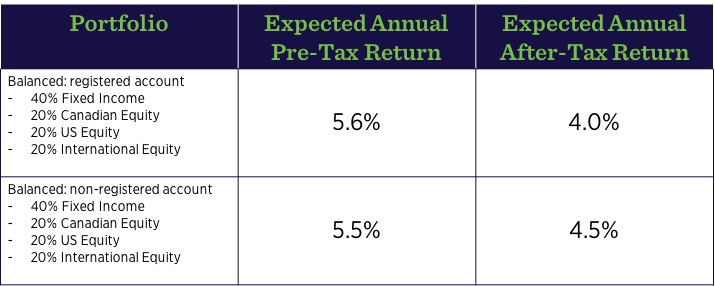
Consider an investor in the top marginal tax bracket who is considered to have an “average” risk tolerance and is invested in a Balanced portfolio of 40% bonds, 20% Canadian equity, 20% U.S. equity and 20% international equity. A reasonable long-term expected annual rate of return on this portfolio, on a pre-tax basis, is 5.6%. Applying tax rates to the interest, dividends (Canadian and foreign) and a conservative estimate for capital gains, the after-tax return on the portfolio is reduced to 4.0%.

By making some minor changes to the portfolio’s asset allocation, such as emphasizing asset classes that receive more favourable tax treatment and finding investment vehicles (ETFs in our case) that are innovatively structured to receive more favourable tax treatment, we can create a new portfolio that is very similar from a high-level asset allocation and risk perspective. The expected pre-tax return on this new, tax-efficient portfolio is slightly lower at 5.5%, but after taxes are applied, the return is a more favourable 4.5%.


The difference of 0.50% in after-tax returns should be considered the MINIMUM cost of tax inefficiency, since we have not yet addressed any other tax-inefficient practices. Extending the analysis across our entire range of investor risk tolerances (from Conservative to Aggressive) shows that the cost of tax inefficiency can vary from a low of 0.40% up to 1.00%. In most cases, the cost exceeds our 0.50% management fee, meaning that you would be better off paying our fee rather than having your assets managed for FREE at any another institution that does not use tax-efficient portfolios!

Continue reading

My search for the next great stock

By Aman Raina, SageInvestors

Special to the Financial Independence Hub

I get asked a lot about how to find companies and stocks to invest in. Where do you start? It’s a great question and also an overwhelming question to people. They’ve set up the broker account. They put in some money. They’re now ready to buy stocks. Where to start?

A few years ago I wrote a blog on how to find stocks to invest, where I suggested a simple and easy starting point in identifying companies to evaluate. The premise was identify the core necessities of life that we need on daily basis and find those stocks that offer that value proposition. The necessities of life are essentially food, clothing, shelter, and transportation (I may add another one communication). Identify the companies in each pillar and evaluate them to find the best run, best managed, best performing.

These days, one of the prominent business thought leaders is Scott Galloway. He is a walking market research machine and can hit with you with so much data you’ll faint. If you want proof check out one if his presentations.

Galloway blogs as well and awhile back he posted a piece of how Uber could get its groove back after all the leadership missteps. He mused on the following:

“…Begin thinking of Uber as an OS. The most impressive firm of the nineties was the original gangster leveraging the operating system — Microsoft. The most influential firms of the last decade, the Four (Amazon, Apple, Facebook, and Google), have become operating systems for retail, media, connections, and information, respectively … and extract serious rents from the apps that sit on top of the OS. What firm has busted a move and blown through $100B market cap that isn’t effectively an OS? The latest, Netflix, has taken advantage of the extraordinarily lame cable industry and now occupies the second-most-important screen, the television. Netflix has increased its market cap 2400% in the last five years.

In sum, the only way Uber gets from $70B to $700B is to become the OS for travel, becoming the user interface / API / rules for all transportation. Leveraging AI, cheap capital, and relationships with 40M of the planet’s wealthiest consumers each month, Uber should expand its offering (dramatically). Same interface, but instead of entering “ACK airport,” where I’m headed Sunday morning, I type in “London,” and using AI — connecting the dots of my preferences, economic weight class, deals at the time, APIs — Uber presents the best options for not just the ride to the airport, but the flights to JFK, then London, the car that picks me up, and the hotel I stay at. Uber has the license to do this. The ride-hailing firm can’t get there on its own and will acquire other firms…”

It’s a pretty compelling argument and it made me wonder what other “OS’s” are out there in other industries? Then I thought about my pillars, food, clothing, shelter, transportation? Has anyone staked their claim as owning the OS for these pillars? Where would Google, Amazon, Facebook, Apple play in this? I thought it would an interesting exercise to carry out and may it can uncover some interesting investment opportunities. My search for the next great stock had begun.
Continue Reading…

How to stop worrying and embrace market Volatility

By WisdomTree ETFs
Following one of the most tranquil years in stock market history, volatility came roaring back in late January and early February. Many investors were calling for the inevitable return of volatility in 2018, ourselves included. That said, few foresaw how quickly and how violently that prediction would come to fruition. While there was some debate as to what exactly prompted the pickup in volatility (with everything from inflation to inverse volatility exchange-traded products to the all-encompassing “quants” being blamed), the bottom line is that the spike in the Volatility Index (VIX) left equity investors running for cover.


One thing we found interesting was that during the height of the correction, the MSCI Emerging Markets Index outperformed the S&P 500 by almost 150 basis points on the downside, with other emerging market (EM) strategies holding up even better.1 Given that the EM asset class historically has had a standard deviation about 50% higher than that of the S&P, EM investors who may have expected the performance of EM to be worse than that of the U.S. were likely pleasantly surprised.

Valuation’s impact on Beta

The EM outperformance brings to mind a concept that Jeremy Grantham has written about: beta is a critical component of explaining relative performance, but valuation can influence beta. Assets that are more expensive relative to their history may experience volatility above their expected levels (and vice versa). When an asset’s price outruns its fundamentals, a downturn in the market can be disproportionally negative when the music stops.

This is the exact same idea that underpins WisdomTree’s original investment philosophy and why we focus on fundamentals. Regarding those fundamentals, within EM we remain encouraged by corporate earnings and believe that the attractive valuation currently offered by the asset class is being underappreciated. As such, the recent sell-off may have provided us with a live case study that validates the dynamic beta concept.

Using Volatility as a Buy signal

As our Chief Investment Strategist Luciano Siracusano recently noted, when the VIX spikes upward, the following 12 months historically have seen strong returns for the S&P 500. Taking it a step further, while elevated VIX levels have portended good times for U.S. equity investors, EM equity investors have had even greater reason to cheer. Continue Reading…

Stop cheating yourself out of tax savings: Tips to get the biggest refund

By Clayton Brown

(Sponsor Content)

The CRA might not exactly be falling over themselves to help you get a nice tax refund. A recent audit showed the agency blocked more than half the calls it was getting (that’s 29 million calls out of 53.5 million) because … well, it just could not handle all of the call volume.

And even when Canadians did get through, agents gave the wrong information about 30 per cent of the time. So, Canadians might need a little help in figuring out how to file their taxes the right way; ideally, so they get the maximum refund they deserve.

Here are some things you can do around tax time to make sure you get the money that should be coming to you:

Take your deductions and claim your credits

The CRA likes its revenue but successive governments have created various options to give the taxpayer some breathing room. Deductions are one of the few variables in your favour, lowering your taxable income, so make the most of them.

Probably one of the best known ones comes from RRSP contributions.

You can contribute up to 18 per cent of your previous tax year’s earned income, plus unused room carried forward from previous years. This helps you pay less tax now, and assuming your income is lower in retirement, also helps you pay less tax later on. By now, you should have all your RRSP receipt slips from your financial institution. (Make sure you keep those receipts, in case auditors come calling).

Another tactic: claiming deductions for child care costs. The government wants to encourage parents to buff up their skills and improve their job prospects. For instance, you can deduct up to $8,000 per child who is under 7 years old. For children aged 7 to 16, you can deduct up to $5,000 for those eligible child care expenses.

Canadians can also claim the interest on certain student loans as a credit. This credit is not like a deduction (where a $1 deduction translates into $1 less taxable income, up to a limit). However, it can still significantly lower a tax bill for those struggling to finally pay off student debt after they’ve finished school.

There are many more deductions and credits available, so don’t leave money on the table!

Love those Spousal RRSPs

Marriage is a beautiful thing. Being with the person you love, sharing memories … and don’t forget about those tax advantages! (Technically, they also apply to common-law spouses, so you don’t have to get hitched to reap the rewards).

These tips generally apply where one spouse earns quite a bit more than the other. In that case, it can make sense for the higher-earning partner to contribute to a Spousal RRSP.

So, let’s say Ned makes $80,000 in salary at his engineering job. Meanwhile, Ned’s wife, Claire, earns just over $50,000 as a manager in an electronics store.

They are both contributing to their own individual RRSPs (Ned saved $6,000 in his. Claire saved $4,000). But Ned also puts $5,000 into a Spousal RRSP. Since Claire’s income is lower, she is the holder of the Spousal RRSP and she will be the one withdrawing income from it. The ideal result, if they’re doing it right: when she makes a withdrawal, it will be taxed at a lower rate than if Ned withdrew it from his own RRSP. Continue Reading…